

A Comic Book for these Apocalyptic times
*Full disclosure team: This book came to my attention via Abrams ComicArts, who will also be publishing my debut graphic novel in 2021* -BeancanDan
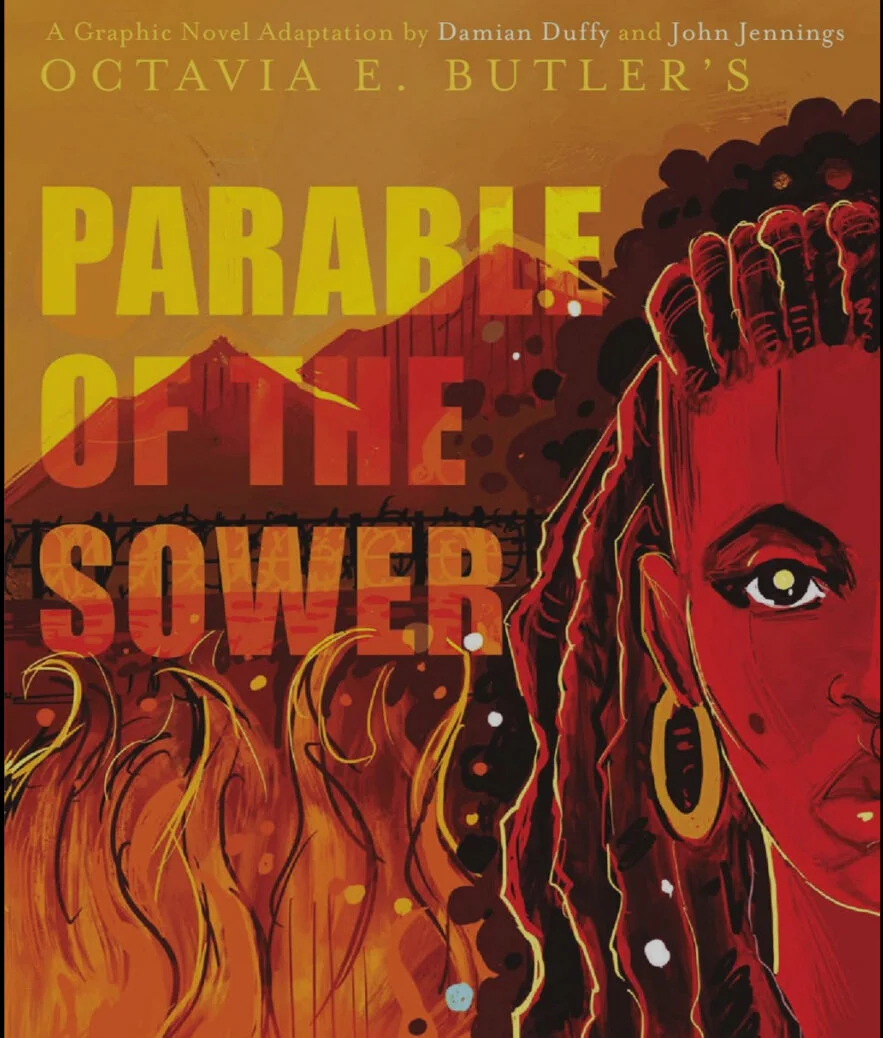
It’s March 2020, and as Oakland, California goes on lock-down, I can tell you that Damian Duffy and John Jennings’ new graphic novel adaptation of Octavia E. Butler’s Parable of the Sower may be the only apocalyptic comic you’ll still want to read after watching the news these days, and I’ll tell you why.
Positivity in the face of Apocalypse
We are Earthseed.
Parable of a Sower opens in a community of struggling Californian suburbanites. They built walls topped with pigeon-exploding concertina wire to protect their cul-de-sac from those who have it even worse. The walls keep out the homeless, the sick, and refugees from similar communities that were burned to the ground. It’s an alarmingly relevant setting. Between our real-world wildfires, power outages to prevent fires, housing crisis, ever-looming threat of a high-magnitude earthquake, and the current COVID-19 pandemonium, it is easy to imagine Parable of the Sower’s dystopian landscape arriving in a very near-future. But the apocalyptic themes of this book are not what makes it such a timely release. There’s plenty of apocalyptic fiction out there, but I wouldn’t recommend reading The Road right now. Parable of the Sower stands out among other apocalyptic tales because it’s not hopeless, and that is the book’s greatest strength. Parable of the Sower is a book about trying times, but it is also a book for trying times. It’s a about making a path toward a better future by carefully navigating a worse one.


Lauren Oya Olamina is the daughter of a Baptist minister, and is one of the only people in her community that refuses to ignore the problems facing her world and also refuses to give in to those problems. Lauren tries to get her friend to prepare for the worst by studying native plants and making a get-away-pack, but she is scolded for it. When the worst comes, Lauren is physically and mentally prepared while others are not. Lauren is pragmatic to the extreme, and finds herself creating a religion based around that pragmatism by exploring all the knowledge she can find, and boiling it down to what feels absolutely and indisputably true. This exploration leads her to believe, among other things, that human life must find a way to live among the stars.
When I first got this book I was skeptical. I know from experience that it can take many pages of illustration to communicate a single paragraph of prose writing. Could a comic do anything but fall apart when trying to adapt a prose novel of a similar length? How far can you boil down a story before it loses its taste? And yet Damian Duffy and John Jennings have made an entertaining and thought-provoking graphic novel with clear and communicative cartooning. While I have have yet to read Butler’s original Parable of the Sower, I’m a fan of her Lillith’s Brood trilogy, and enjoyed the graphic novel’s use of narration which helped the book feel like a true collaboration between Duffy, Jennings, and Butler by infusing the comic with Butler’s voice.
If you love comics and are Octavia Butler curious, this would be a good place to start. If you’re looking for a comic about finding a path through trying times and beyond, or looking for an easy-to-read book as a way to talk about disaster preparedness and planning in the face of bleak news with students, family, or friends, this adaptation of Parable of the Sower is for you.
For my part this book has finally got the original Parable of the Sower on my “to read” list after a decade of intermittent recommendations, and I’m excited to dive into it soon!
Looking for more Beancan Book Talk? Join the Club!
Support your local comic shops and bookeries with the COMIC SHOP LOCATOR or if you’re going to amazon, consider using the links below…
They put a some change in the ol' beancan if you buy here ¯\_(ツ)_/¯