


Dedicated to anyone who has died, will die, or loves someone who is dead.
A Film About Billy
A Note From the Author:
A couple of people I cared about chose to leave this world behind before any of us turned 18. I wrote this book back when the term “pandemic” had to be explained to the average person, and I’m not sure you should read it. It’s only for a small group of people to enjoy fully… if enjoy is even the word.
I was young and angry when I wrote it. There will be some dark thoughts and hurtful words. If you found this story, this place, because your thoughts are already straying darkly. If you find yourself thinking of self-harm, you can find help HERE AT THIS LINK. PLEASE DO SO.
Please.
I am literally begging you.
Taking care of yourself in this moment is so much more important than anything I have to say.
…
Two days ago, one of the authors who blurbed this book took his life as well. He was the second addition to suicides in my sphere of acquaintance since the publication of this book (third NoW, an Ex of mine went a few months later). I can only guess how many more people are holding their stomachs—full of the same shiny black nonsense that stayed with me from my teens to twenties as I wrote this book. The frustration, anger, sorrow, regret, and appreciation get all mixed and turn into something different.
For me, they turned into this book. it helped me feel better somehow. If you are the right kind of person, I think it might help you in the same inexplicable way.
But again, this is not for everyone. It might not be a story you want to read.
There is no shame in closing this page instead of reading on.
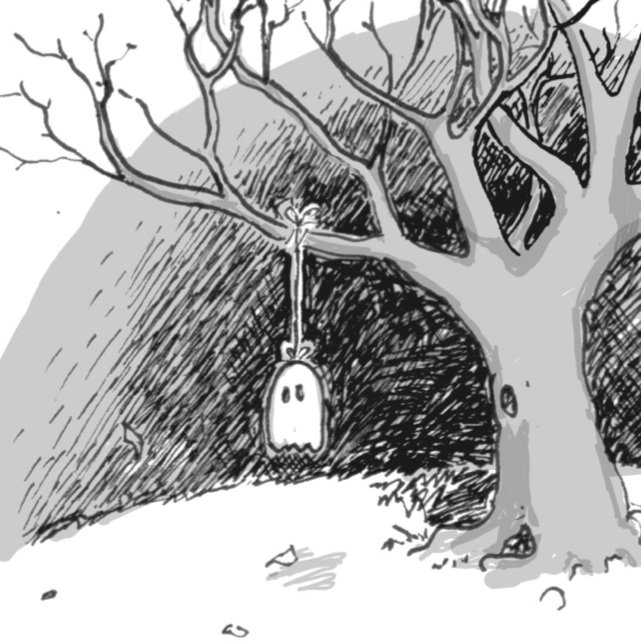
Most books are haunted. This one certainly is. By me if no one else. But I hope to be a gentle ghost. I hope to be the whisper that reminds you to call your grandma and step outside to feel sunshine on your face.
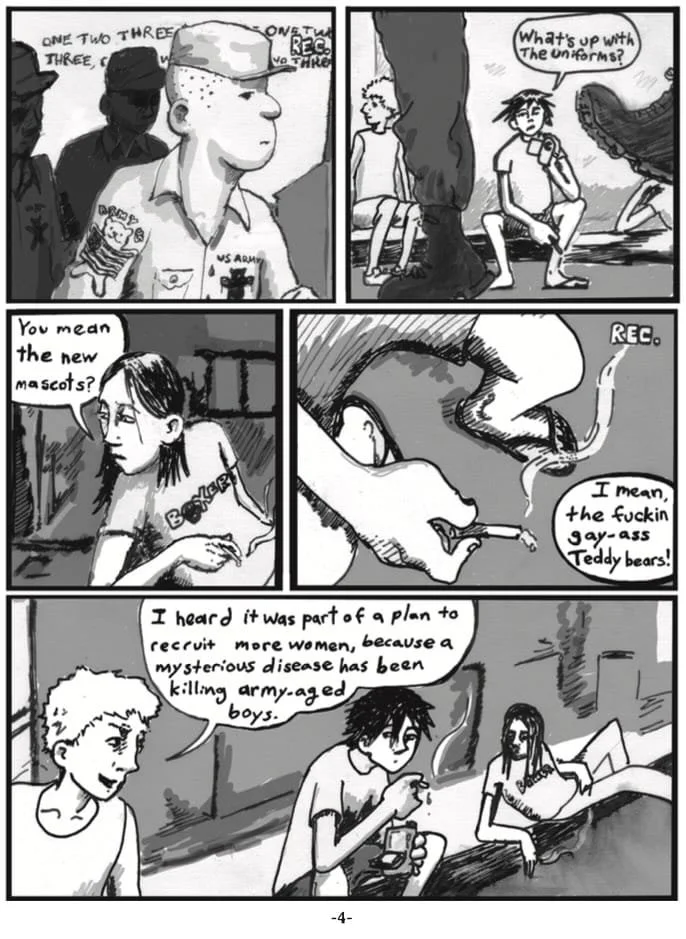
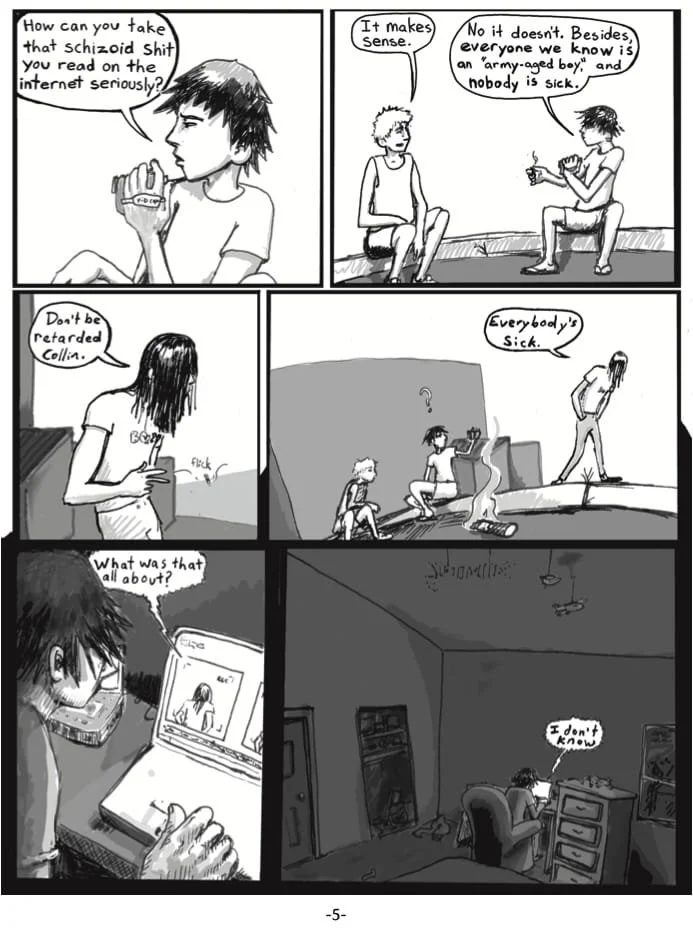
This is a novel that alternates between comics and prose.
This is A Film About Billy…

Chapter One
A Film About Billy
When I was in high school, my cousin Dan and I skipped class and went to see a lecture by a guy named Andrew Furmaniuk at a nearby university.
Furmaniuk made movies. Lots of movies. All the time. He would think up plots on the way to shoots, which were mainly at his actors’ houses. These plots were almost always disjointed and usually smutty.
In a world of glossy books, hot dogs, and Hollywood features, Andrew Furmaniuk made gritty, half-assed, whole-hearted flicks. Flying saucers on strings and backgrounds drawn in colored pencil. Everything about him screamed, “You can do this.” And for some reason, Dan and I thought, “Maybe we should.”
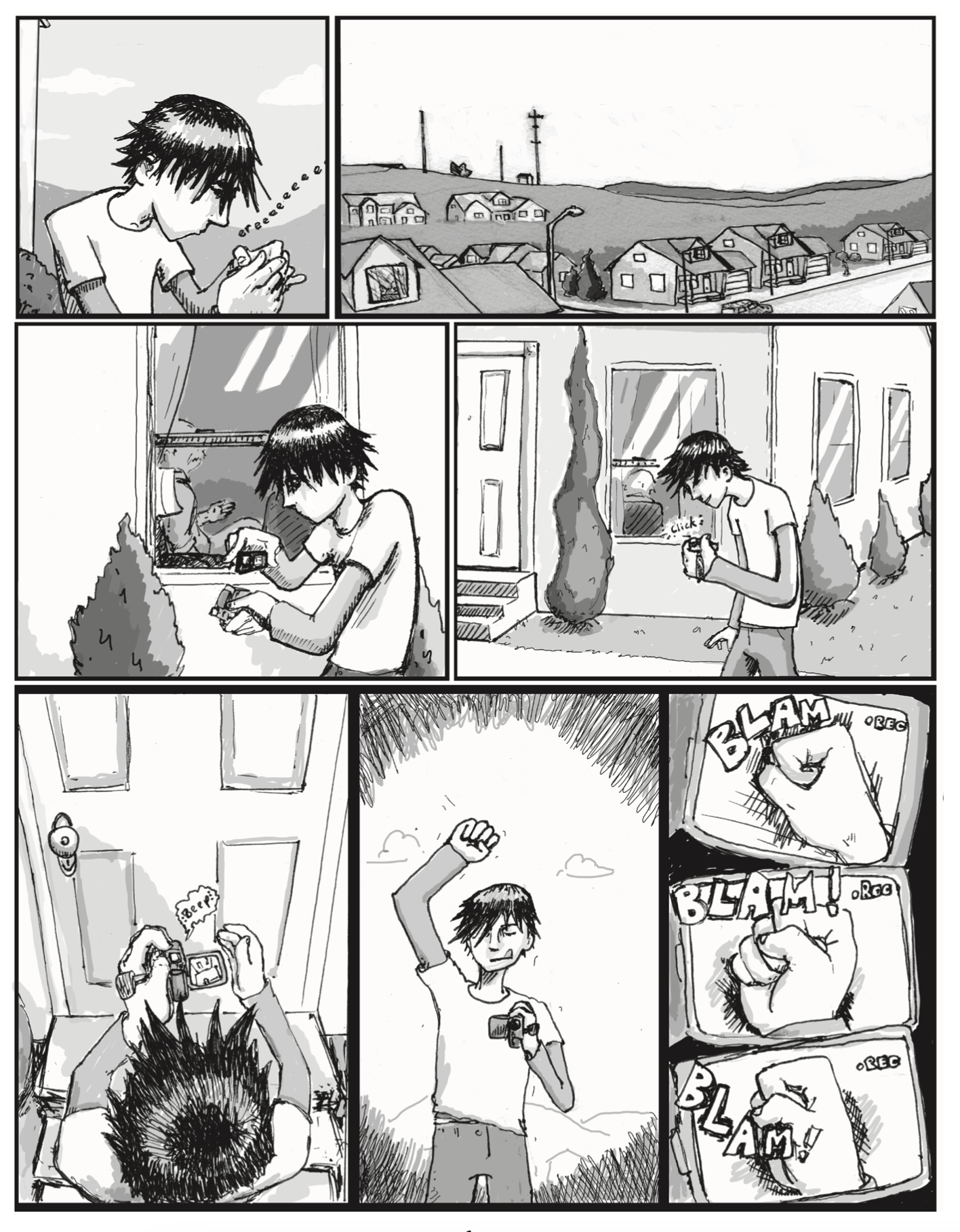
We split the cost of a video camera in December of our senior year, and from that point on, we filmed everything. For about three months before Billy died, and two months afterward, there was barely a word spoken that we didn’t catch on tape.
After high school, I moved to Pittsburgh, two hundred and fifty miles away from my old town and my old friends. I started cutting a movie on an artist’s grant, editing together a documentary about my dead friend, making a film about Billy.
Chapter Two
My Father’s Room
After a month living in Pittsburgh in my dad’s old bedroom, I hadn’t changed a thing. Wooden molecules collected dust on the dresser and a yellowed comic book stash rotted under the bed. The only contributions I made to the space were the clothes on the floor and the laptop and DV deck on the desk.
I shut down the computer but left the DV deck running. I pulled a sheet of labels from the desk drawer and wrote down a date and a title— “Sick.” I pushed myself out of the armchair I used as a desk-chair and stretched while the tape rewound.
I lifted my jacket from a pile of shirts and tugged it on as the whirring changed pitch with shifting gears. I patted my pockets to make sure there were cigarettes in them before stepping toward the desk and lifting my finger to the eject button right as the tape went “click.”
How many times did I do that? How many times did I pop a tape, stick on a sticker, and throw it in the drawers of my father’s bureau?
Hundreds of times—there were hundreds of tapes. I took hundreds of yellow legal pads filled with thousands of notes and slipped them in the bureau too, before going to sleep, grabbing a snack, or (this time) zipping up my coat, ready for a nighttime stroll.
On my way out, I stopped to read a note sitting on the kitchen table. It was written in shaky cursive, said there was dinner in the fridge in case I wanted it, and said that Jane had called.
Chapter Three
Jane
I dialed Jane’s number on the rotary phone in the dining room. The whirring digits annoyed me as usual if something happened to Grandma (if she fell, if she suffered a stroke or a heart attack) this would waste precious time. I pulled the cord from the dining room into the kitchen and shut the door, so I wouldn’t disturb her in her room.
“Hello?” Jane sounded confused and groggy.
“Did I wake you?” I said.
“It’s five a.m.,” she groaned.
I checked the clock on the microwave. She was right. “You called the house.”
“Yeah,” she said. “Like ten hours ago.”
“Why did you call here?”
“Jesus, Collin, I wanted to talk to you. I thought your grandma would know where you lived. Why didn’t you tell me you were staying with her?” Jane’s family lived next door when I was little. We played together whenever dad and I visited. But, when Jane’s father got a job in Connecticut, we lost touch. Ten-year-olds aren’t always correspondence buffs.
We didn’t talk again until after I moved to Pittsburgh. I was lying flat on my back, smoking cigarette butts on Carnegie Mellon’s campus when I noticed someone staring at me. She said I looked just the same.
“How did you get this number?” I said into the receiver.
“The phone book. What is wrong with you?”
“Nothing’s wrong with me. I just. . .” I lost myself in the pattern of the kitchen linoleum. “I just need a cigarette.”
Jane sighed. “Well. Since I’m up, do you want to get breakfast?”
“No. I’m going to sleep.”
There was a small sound, maybe of teeth, before Jane asked, “Why are you treating me like this?”
“Don’t call here anymore,” I said. “Okay?” Click.
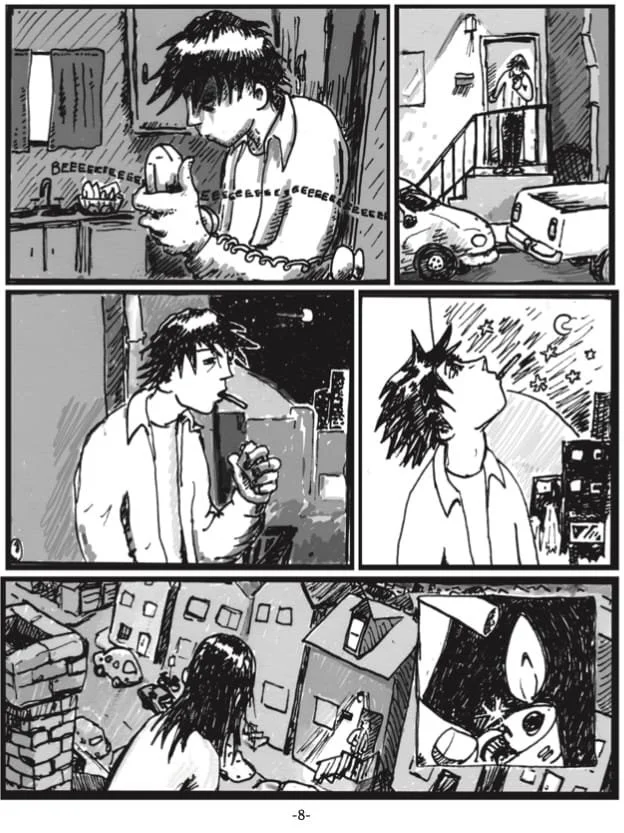
Chapter Four
Tom
When I woke up I was feeling okay. It was nice to sleep in my bed for once instead of passing out in that chair in front of my computer. My grandpa used to fall asleep in that same chair all the time, and I was starting to think it was the chair that made him so old.
“Morning, Honey,” Grandma said. It was three-thirty. She was having tea and scratching her daily lottery ticket.
I was coming down the stairs and wiping my eyes open. “Hey, Grand-mum.”
“Would you like some?” She peered through heavy plastic lenses at the red and gold cardboard square. Her cheeks jiggled as she spoke.
“No, thanks.” My grandma was a first-generation Irish immigrant and put more tea bags in the pot than water.
“Oh, come on. Have some tea with your grandmother.”
I hesitated, but I didn’t care that much either way. So, I went to the kitchen to get a cup and saucer and filled a quarter of the cup, so there would be plenty of room for milk and sugar.
In the dining room, Grandma grumbled and lifted the card close to her face, double and triple-checking the ticket. There was a TV playing Fresh Prince reruns in the corner, but the audio was way down.
I sat across the table from her and sipped.
Grandma glanced at the television and then at me. “I had a nice chat with Jane Brenden yesterday after you locked yourself up for the evening.”
“I know,” I said. “I saw the note.”
“Why didn’t you tell me she lived here?”
I shrugged. I didn’t tell Grandma because I knew she would want to invite Jane over and have dinner and stuff like that. I wanted to keep my distance. I had work to do upstairs.
The jingle for local news pulled my attention to the TV because it was loud and that’s what it was designed to do. “Tonight at eleven: What are Pittsburgh teens doing on Japanese suicide websites?” The screen cut to a girl in her twenties with dark hair. “It’s pretty disturbing,” the girl said.
“She’s going to college here.” Grandma lifted the remote and pressed mute.
The girl with dark hair disappeared from the screen. “I know,” I said. “That’s where I saw her.”
“What does she look like?”
“I don’t know. Her hair’s brown now.” I blew on my tea. Brown hair, brown eyes, olive skin. Dark rings that loop around long lashes. A stupid tattoo of a paw print on her hip, below the pant-line.
“Is she pretty?” Grandma asked me, slurping black tea through puckered lips.
“Sure.” I shrugged.
“Did she fill out?”
“Grandma.”
“She did, didn’t she? Little girls with big eyes always fill out.”
I cringed. “You’re just making that up.”
“I had pretty big eyes when I was young,” she winked. “That’s why I have so many back problems.”
“Grandma.” I tried to think of people with big boobs, but the only girl I knew with any breasts at all was Jane. I shook my head.
Grandma giggled. “Anyway, it’s nice that you’re talking to girls your own age. It’s not healthy to lock yourself up and only talk to your grandmother. Not that I’m complaining,” she added. “You know what we should do?”
“What?” I took a sip of tea and added more milk. “We should invite Jane for dinner.”
I sighed. “I’m going to work.”
“Next Friday.”
“No,” I said.
“Please.” Grandma placed her own cup in its saucer.
“Why?”
“Well,” she said. “I met this man—”
“Wait,” I said. “What?”
“His name’s Tom.”
“What?”
“I met him at the salon. He comes in for a shave and a tr—”
“What?”
“Collin,” she said.
When I said nothing, my grandma continued. “He’s a sweet man. I’d like you to meet him.” A grin was creeping across her face. “Oh, Collin, he used to be an engineer. He has the most handsome mustache and a full head of hair. You don’t have to bring Jane, but it would be more fun if you brought someone.” Her head tilted, perm bobbing. She was really happy.
“I,” I said. “I have to go to work.”
Grandma laughed, and I slowly turned and retreated into my room.
Chapter Five
Mint Grant
When I was a kid—after my mom left—my dad never dated. He didn’t seem interested in anything but work and sci-fi comics. Maybe that was why the idea of my grandma going on a date seemed so strange.
Or maybe the idea of double dating with your grandma would be weird to most kids my age. I wasn’t sure. I was falling out of sync with the world. My grandma was right. It wasn’t healthy to be so reclusive. Since the stairs to my room were too steep for Grandma to climb, there were whole days when I didn’t see her at all. At first, she tried to call me down for dinner, but I was usually too engrossed in my work to hear.
I had seen Jane four or five times when I needed more cigarettes, but for the most part the only people I saw were on my computer screen: Jeff, Colleen, Billy, and Dan.
And in a way, that was okay with me. The less people I knew, the less I could get hurt. But at the same time I realized that I needed to go out—if not to make friends, then at least to be in the company of other human beings.
Sometimes when my dad was in the middle of a big project, he would start seeing DNA in the wood grain of the kitchen table and things like that. I did not want that to happen to me. I did not want to see Billy’s face in my morning toast, and thank god I never did. I doubt I would have ever stopped screaming. I’d eat, screaming with my mouth full. Toothpaste would spray, splattering against bathroom mirrors every night as I got ready for bed. I’d be screaming right now, in the nothing, as I write this.
The artist’s grant I got to work on Billy’s movie was provided by the Mint Endowment, “dedicated to fresh thinking.” The grant was for seven thousand dollars, small by the Mint Endowment’s standards, but enough for me. They gave me four thousand to start and would give me the rest as I went through the process. I spent about half of what they gave me on my DV deck and computer and tried to give most of what was left to my grandma, but since she wouldn’t take it, I was left with a pretty big cigarette and booze budget (for better or worse).
The grant was straightforward. Usually they would just give you the money, and in six months to a year, the artist would present their completed project to a board assigned by the endowment. For me, they did it differently.
At seventeen I was the youngest person to receive a Mint grant. Consequently, they allowed me the grant on the stipulation that I meet with them twice prior to the completion of my film (once every three months). I had just under two months before the first meeting and had three tapes left to label and annotate.
The tapes were an hour long. But because of how often I paused to write things down or just take a break, it would usually take two or three hours to get through one. I filled legal pads with a detailed breakdown of each cassette’s contents—the quality of the footage, moving words, and beautiful visuals that might be used in my film. Or at least that’s how it was for the first couple hundred tapes.
Recently I had started losing some of my professionalism. The last ten, maybe twenty, tapes I had barely written about, and it had been taking me longer to get through them.
Sometimes I would find myself doodling instead of watching or just closing my eyes.
I promised myself that after these last three tapes, I would take a day off.
Then the real work would start.
Hey. It’s me again… Dan, the author. It looks like it will take me a LoNG time to get the full book up here, and it may never happen. I’m falling behind on a few other projects. For now, I’ve made the PDF free in my store, so feel free to download it and take it with you.
If you’ve already read it all, you might be happy to know I’m Okay. That I’m In Love. That I’m OUt Here Trying. Getting up every day to make the comics equivalent of films with flying saucers on strings. If You Have yet to read it, I’ll tell you this:
People care about you more than you know.
Hang tough, Drink Coffee, make things no one asked for.
<3
BeanCan Dan
I made this pdf free but you might still need to go “check out” in the store. Tell me if you have any trouble. -Dan

A Film About Billy is a novel that alternates between comics and prose to tell the story of Collin Heart—a 17-year-old editing a documentary about his dead friend during an international suicide epidemic.
"Dan McCloskey’s debut novel is a surprise; a rollercoaster; a caustic, bitter, and honest work. What begins as one boy’s journey to make sense of a friend’s suicide unravels in unforeseen directions, a paranoid dystopia of shadow governments, rebellion, fragile hope…and horror. With breathless pacing, delirious graphic images and razor-sharp metaphor, McCloskey crafts a deeply human vision of Armageddon that I could not put down."
Elwin Cotman -The Jack Daniels Sessions EP, Hard Time Blues
“Dan McCloskey is one of these new creators whose craft and level of talent increases with each successive page. It’s a pleasure to watch him grow right before my eyes.”
Ed Piskor -Brain Rot, Wizzywig, Hip Hop Family Tree
“An honest, scary, and exciting prose/comics hybrid.”
Jim Rugg -Supermag, Afrodisac, Street Angel